In this article
When you need a TV replacement service
New TVs get bigger and cheaper every year, and plenty of our jobs are people replacing a perfectly good 55-inch with a 75- or 85-inch. The old TV is already on the wall, the cables are already run, and it seems like a five-minute swap. Often it is — but only when someone checks three things before lifting the new screen up.
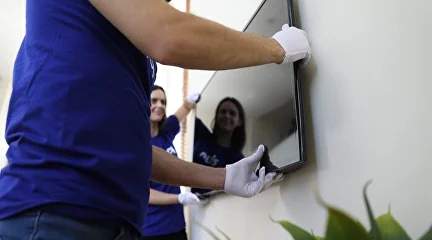
Our TV replacement service covers the whole swap: the old TV comes down safely, the mount is checked against the new TV, reused or replaced, and the new screen goes up level and tested. It's also the service for replacing a broken or cracked TV on the wall, or swapping a TV between rooms.
Will your current mount fit the new TV?
This is the question that decides the price and the time. We check:
- VESA pattern. The mounting holes on the back of the new TV — 300×300, 400×300, 600×400 and so on — must match the mount's plate or arms. Most universal mounts cover a range; a mount for a 43-inch TV often can't reach the wider pattern of a 75-inch. See understanding VESA patterns.
- Weight rating. A mount rated for 60 lb shouldn't carry a 75 lb TV. We want a comfortable margin, especially on full-motion arms.
- Size range. Mounts list a screen-size range. A small plate behind a large TV works mechanically, but the arms may not reach the holes, and the TV can sit off-center.
- Condition. Rust, bent arms, missing safety locks or anchors that have loosened over years are all reasons to replace the mount even when the numbers fit.
If everything checks out, we reuse it and the job is $129. If not, we install a new mount for $169. You can check your new model yourself with the mount finder before booking.
Free tools Mount Finder Pick the brand and screen size to see the pattern that lineup uses, the weight range and mounts that fit. Add the model code for an exact match. Open the tool →Going bigger: height and position
A larger TV on the same mount doesn't sit in the same place. The screen extends further below and above the plate, so a TV that was at a good height as a 55-inch can end up too low for a soundbar or too high as an 85-inch. When the size changes a lot, we re-check the viewing height and, if needed, move the mount — patching the old holes afterward.
The TV size calculator shows what size suits your seating distance, and the height calculator gives the target center height. Going very large? Our guide on the best mount for an 85-inch TV covers heavy-duty hardware.
Rather have a pro do it?
Send a request — we'll confirm the exact price and a time that suits you by text or call. 3-year warranty on every install.
The swap, step by step
On the day, the technician starts by photographing and labeling the cables — HDMI inputs, optical, power — so everything goes back exactly as it was. The old TV is lifted off the bracket (two people for large screens) and set face-up on a soft surface.
With the old TV down, we inspect the mount and its anchors. Lag bolts that have backed out a little are re-tightened; worn or undersized hardware is replaced. The new TV gets the correct bolts and spacers for its VESA pattern — they're often not the ones used for the old TV — and is hung, locked and leveled.
Finally, every device is reconnected and tested, the cables are tidied behind the screen, and the packaging from the new TV is broken down and removed. If you'd like the wires hidden properly this time, add cable concealment to the same visit.
Replacing a broken or cracked TV on the wall
Screens get cracked — a thrown controller, a fall from a stand during a move, a power surge that kills the panel. When the broken TV is already on the wall, the replacement is the same job with a little more care: a cracked panel can shed glass, so we tape the face before lifting it off, and we check the mount for damage if the TV was hit hard.
If the TV died from a surge, it's worth looking at the outlet it was plugged into. We'll point out if the power is coming from a daisy-chained extension or an outlet with no surge protection, and an in-wall power kit installed with cable concealment can give the new TV a proper dedicated outlet behind the screen.
Replacing a TV on a full-motion or pull-down mount
Moving mounts need extra attention when the TV changes. A full-motion arm that carried a 45 lb TV at full extension may sag with a 70 lb one, and the arm's reach may no longer clear a corner with the larger screen. A pull-down mantel mount has to have its spring tension re-set for the new weight, or the TV will drift down on its own or refuse to come down at all. We re-tune both as part of the replacement, and tell you if the new TV is outside what the mount can safely carry.
What to do with the old TV
Most people give the old TV to another room. We can mount it there on the same visit — it's priced as a regular TV wall mounting. If you just want an old TV taken down without a replacement, that's our TV removal and dismount service, and our read on TV dismounting and relocation covers moving house.
TV replacement near you
We replace wall-mounted TVs in Miami and South Florida, Los Angeles, Dallas–Fort Worth, Las Vegas, Houston, Atlanta, Chicago, San Diego, Charlotte, Salt Lake City, Seattle and Raleigh–Durham, seven days a week, with same-day slots. The price is the same in every region and includes tax and the 3-year warranty.