In this article
Why choose a fixed TV mount
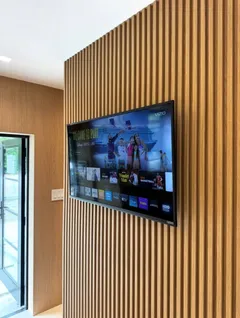
The fixed mount — also called a flat or low-profile mount — is the simplest bracket there is: a wall plate and two arms that hook onto it. The TV hangs an inch or so from the wall and stays exactly where it was put. There's no arm to sag, no joint to loosen and nothing for kids to pull on.
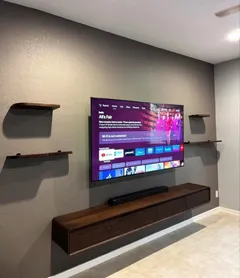
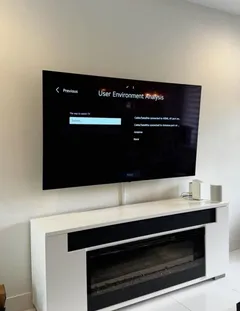
It's also the cleanest look. A fixed-mounted TV reads almost like a framed picture, which is why it's the default for living rooms, feature walls and TVs above a console or sideboard. It's the least expensive mount too: $39 if you buy it from us.
When fixed is — and isn't — the right mount
A fixed mount works when two things are true: the TV can sit at roughly eye level for the main seat, and people watch it from more or less straight in front.
It's the wrong choice when:
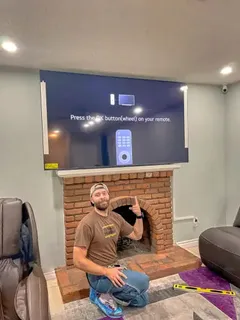
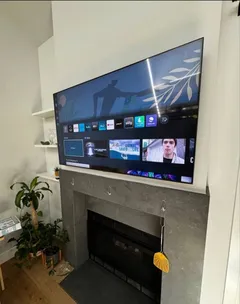
- The TV has to go high — above a fireplace, a tall dresser or a console with a soundbar and devices. A tilting mount angles it back toward you.
- You watch from two places — the sofa and the kitchen, or a corner position. A full-motion mount turns the screen.
- Windows cause glare on the screen at certain times of day. A few degrees of tilt often fixes it.
Our article on tilt versus swivel mounts covers the decision, and the best TV wall mounts compares specific models by use case.
Height matters more with a fixed mount
Because a fixed mount can't tilt, the height you mount at is the angle you watch at, forever. The target is the center of the screen near eye level for your main seat — about 42 inches from the floor for a typical sofa, a little higher for bedrooms where you sit up in bed.
Before drilling, the technician marks the screen outline on the wall so you can see exactly where the TV will be. The TV height calculator gives you the number in advance, and our height guide explains the reasoning.
Free tools Height Calculator Floor-to-centre height, top and bottom edge, how far you look up and whether you need tilt, with a to-scale drawing of the wall. Open the tool →Matching the mount to your TV
A fixed mount has to fit three numbers: the TV's VESA pattern (the spacing of the mounting holes), its weight, and its size. Universal mounts cover a range of patterns — a mount for 32–55 inch TVs usually tops out at 400×400, while a 75-inch may need 600×400. The mount finder shows which mounts fit your exact model, and understanding VESA patterns explains how to read them.
Rather have a pro do it?
Send a request — we'll confirm the exact price and a time that suits you by text or call. 3-year warranty on every install.
Cables behind a flush TV
The space behind a fixed-mounted TV is shallow, and cables are the usual reason a "flush" TV sits crooked. A stiff HDMI cable pointing straight out of the back can push one side of the TV away from the wall. We use right-angle adapters where needed, route cables along the back of the TV and, for the cleanest result, conceal them in the wall with a recessed plate behind the screen — see TV cable concealment.
Fixed mount installation in our regions
We install fixed mounts on every wall type in Miami, Los Angeles, Dallas, Las Vegas, Houston, Atlanta, Chicago, San Diego, Charlotte, Salt Lake City, Seattle and Raleigh–Durham: concrete condo walls, plaster in older homes, metal studs in high-rises and brick and stone in family rooms. See TV wall mounting for the full service, or send a request and we'll confirm the price.