In this article
Why fireplace TV mounting needs a different approach
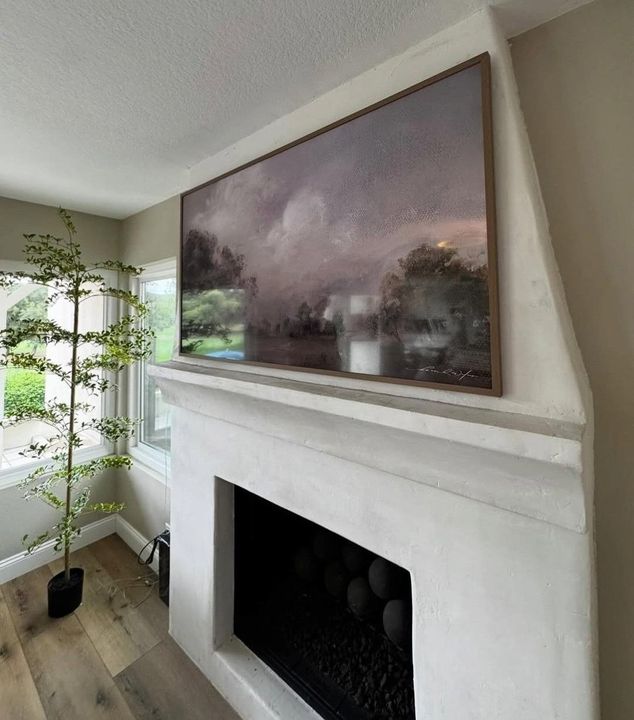
Most living rooms are built around the fireplace, so the wall above it looks like the obvious place for a TV. It can be a great spot — but it's the one wall in the house where three problems meet: heat rising from the firebox, masonry or stone that ordinary anchors can't grip, and a height that is almost always above comfortable eye level.
A handyman who mounts TVs on drywall every day can still get a fireplace install wrong. We've taken down screens hung on plastic plugs in mortar joints, brackets bolted into a thin layer of stone veneer with nothing behind it, and TVs so high they gave the owner a stiff neck after one movie. Our fireplace TV installation service is built to avoid all three.
Heat: the first thing we check
Before we pick a height, we measure. The technician checks the surface temperature of the wall above the firebox and the depth of the mantel. Most TV makers publish an operating limit, and heat that bakes the bottom edge of a screen shortens its life and can void its warranty.
A mantel that sticks out 6 inches or more deflects most of the rising heat. Where there's no mantel, or the fire is used often, we recommend mounting higher with a tilting mount, adding a mantel or hood, or choosing a pull-down mount that keeps the TV up while the fire is on and lowers it when you watch. Gas and wood fireplaces are handled differently from electric inserts, which mostly vent warm air — we explain the difference in mounting above an electric fireplace.
What's behind the fireplace wall
The surround can be drywall on wood framing, solid brick, concrete block, natural stone or thin stone veneer glued to cement board. Each needs different hardware:
- Framed chimney chase with drywall — the easiest case: lag bolts into studs, just like a regular wall.
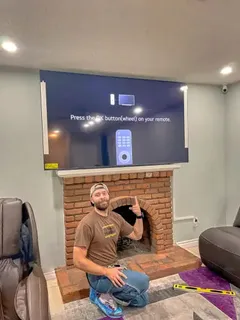
- Solid brick or block — a hammer drill and sleeve or wedge anchors set into the brick itself, not the mortar. Mortar crumbles under load over time.
- Natural stone — uneven faces need shims or a mount with adjustable standoffs so the plate sits flat and level.
- Stone veneer — thin veneer can't carry a TV on its own. We anchor through it into the structure behind, or find studs beside it.
The details are in our guide on drilling brick versus stone veneer, and we handle a lot of stacked stone in Texas — see stone and uneven surfaces.
Rather have a pro do it?
Send a request — we'll confirm the exact price and a time that suits you by text or call. 3-year warranty on every install.
Getting the height right
The comfortable height for a TV is with the center of the screen near eye level when you're seated — about 42 inches from the floor. A fireplace mantel is usually 50–60 inches high, so a TV above it will always be higher than ideal. There are three ways to manage that:
Tap a type to see how it moves on the wall.
Mount it low on a fixed bracket. A slim fixed mount lets the TV sit as low as the heat clearance allows — we keep the bottom of the screen a few inches above the mantel, not a foot above it.
Tilt the screen. A tilting mount angles the picture down toward the sofa, which cuts the viewing angle and glare from windows.
Pull it down. A pull-down mantel mount lets you lower the TV to eye level when you watch and push it back up after. It's the best answer for tall mantels.
The fireplace TV height calculator gives you a starting number for your mantel height, TV size and seating distance. Our longer read on mounting a TV over a fireplace covers the trade-offs in detail.
Free tools Fireplace Planner Where the screen really ends up, the angle it forces, heat clearance for your fireplace type, and whether tilt is enough or you need a pull-down. Open the tool →Hiding the wires above a fireplace
Nothing spoils a fireplace wall like a power cord and an HDMI hanging over the mantel. How we hide them depends on the wall:
- If the chimney has a framed chase or there's a hollow wall beside it, cables run inside the wall to a recessed plate behind the TV and come out near an outlet.
- On solid brick or stone, a narrow raceway runs down the side of the surround and can be painted to match.
- If you'd like power right behind the TV, we can add an in-wall power kit where the wall construction allows it.
We never run cords through a firebox wall or tape them to hot surfaces. All the options are laid out on our TV cable concealment page.
Fireplace mounting mistakes we fix most often
A good share of our fireplace jobs are second attempts. The same problems come up again and again:
- Anchors in the mortar joints. It's the easy place to drill, and it's the weakest part of the wall. Mortar crumbles over months, and the bracket slowly pulls out.
- Bolts into veneer only. Thin stone looks solid but is only glued to board behind it. Loaded with a TV, it can crack or come off the wall.
- Too high, no tilt. A flat mount two feet above a tall mantel puts the center of the screen at 80 inches — you watch looking up, and the picture washes out from the angle.
- Cords draped over the mantel. Or worse, stapled across the stone. It looks temporary and it's a snag hazard.
- No heat check. A TV mounted tight over a wood-burning fireplace with no mantel runs hot at the bottom edge every winter.
Each one is fixable. We remove the old bracket, fill the holes, re-anchor into solid material and, where it helps, swap to a tilting or pull-down mount. If you're replacing the TV at the same time, see TV replacement.
Fireplace TV installation in every region we serve
Fireplaces look different in each of our regions. In Dallas–Fort Worth it's mostly brick and stacked stone in family rooms; in Los Angeles we see older plaster and brick fireplaces and modern linear gas units; in Las Vegas, gas inserts in stucco-built homes; and in South Florida, many fireplaces are electric or decorative. Houston and Atlanta family rooms are built around brick and stacked stone, Chicago has century-old brick fireplaces in two-flats and bungalows, and San Diego adds stucco and slump stone. Charlotte family rooms bring back brick and stacked stone, many Salt Lake City homes have a second fireplace in the finished basement, and Seattle's Craftsman houses have old brick fireplaces set in plaster walls. Around Raleigh, older houses inside the Beltline pair plaster walls with brick chimneys, while newer homes in Cary and Apex build two-story family rooms around stacked-stone fireplaces. Our crews in Dallas, Los Angeles, Las Vegas, Miami, Houston, Atlanta, Chicago, San Diego, Charlotte, Salt Lake City, Seattle and Raleigh–Durham work with all of them every week, at the same flat price and with same-day slots.