Mon–Sun 8am–8pm Same-day service · Flat-rate pricing

TV Cable Concealment — Hide TV Wires In the Wall or in a Raceway

Cables hanging under a mounted TV undo half the point of mounting it. We hide them two ways — inside the wall with a proper in-wall power kit, or in a slim paintable raceway where the wall can't be opened — so the only thing on the wall is the screen.

Why homeowners book us

  • Two clean options: in-wall $69 or paintable raceway $39
  • Code-compliant power — in-wall rated kits, never a power cord stuffed in the wall
  • Any wall: drywall, plaster, concrete, brick, fireplace surrounds
  • Renter-friendly raceway option with no cutting
  • Same-day slots, 3-year warranty
Call (877) 676-8880
★★★★★ 4.9★ from 480+ reviews 3-year workmanship warranty Crews in 12 US metros

Submit a request

Tell us about your TV and the wall — we'll confirm the exact price and a time that works for you by text or call.

What you get

What our TV wire concealment includes

Hiding wires well is mostly about using the right parts and knowing what's inside the wall. Here's what you get.

TV Cable Concealment — a TV Mount Q installation

In-wall concealment

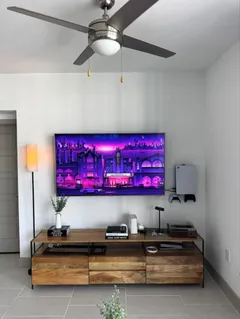
Cables run inside the wall from behind the TV to a recessed plate near the floor or the console, with in-wall rated HDMI.

Proper in-wall power

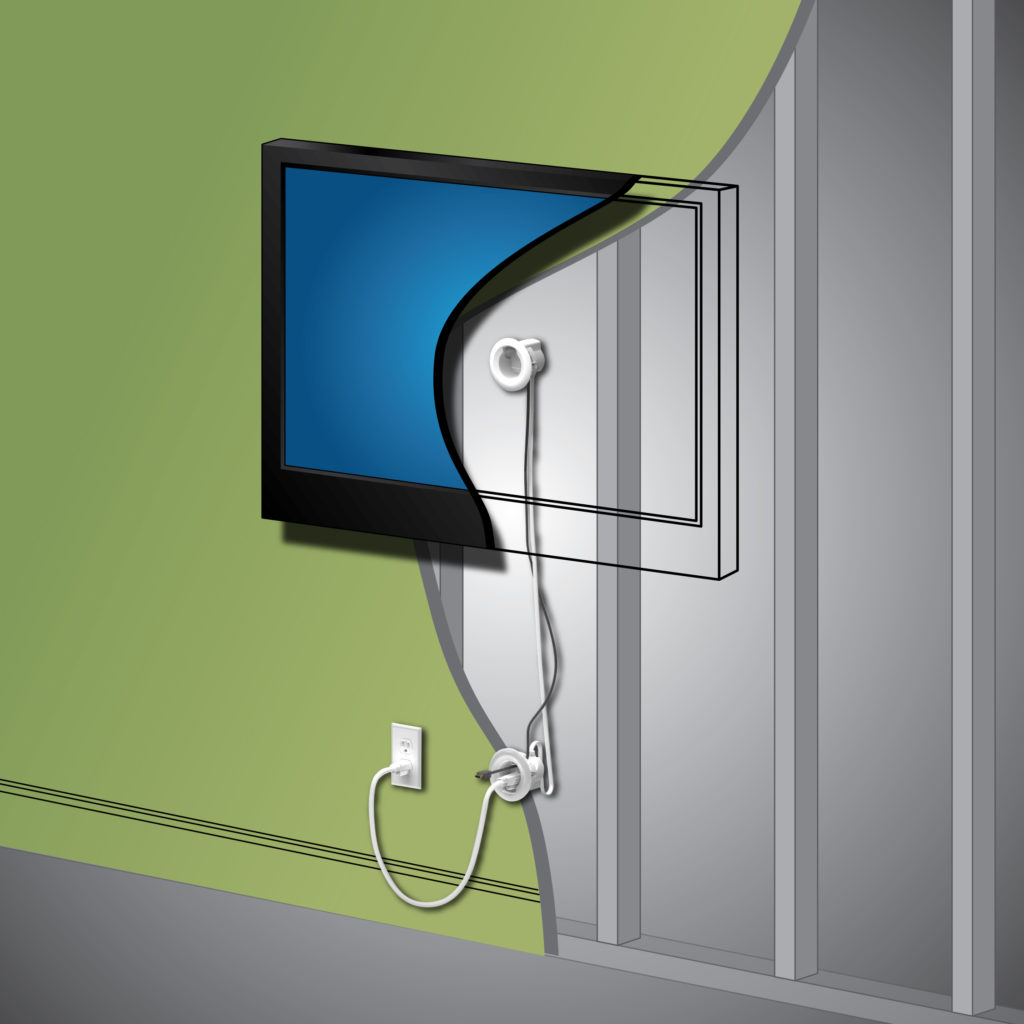
A recessed power kit gives the TV its own outlet behind the screen — the safe, code-compliant way to put power in the wall.

Paintable raceway

A slim channel on the wall surface for concrete, brick and rentals: no cutting, straight lines, painted to match.

Scan before cutting

We scan for studs, fire blocks, pipes and existing wiring before opening the wall, and plan the route around them.

Clean finish, 3-year warranty

Openings are sized for the plates, dust is vacuumed, and the whole job is covered for three years.

In this article
  1. Why hide the wires at all
  2. Option 1: In-wall concealment
  3. Option 2: Paintable raceway
  4. Which one is right for your wall
  5. Hiding wires for the whole setup
  6. Renters and HOA rules
  7. Cable concealment in our regions

Why hide the wires at all

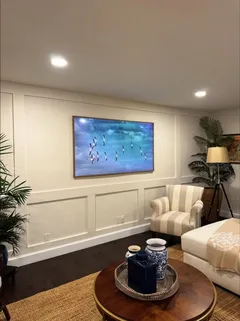
A wall-mounted TV looks clean in photos because the photos never show the cables. In a real living room, a power cord and one or two HDMI cables drop from the bottom of the screen to the floor, and your eye goes straight to them. Hiding them is the difference between "we put the TV on the wall" and "it looks like it was designed that way".

There's a practical side too: cables hanging loose get pulled by kids and pets, catch vacuum cleaners and gather dust. Our TV cable concealment service gives you two ways to get rid of them, depending on your wall and whether you own or rent.

Option 1: In-wall concealment

This is the cleanest result. Two neat openings are cut in the drywall — one behind the TV, one near the floor or behind the console — and fitted with recessed plates. Cables run inside the wall between them, and nothing is visible once the TV is up.

The important part is power. An ordinary TV power cord is not rated for use inside a wall, and running one there is a fire-code problem. We install an in-wall power kit: a recessed inlet near an existing outlet, in-wall rated cable inside the wall, and a recessed outlet behind the TV. The TV plugs in behind itself, and nothing electrical is hidden that shouldn't be. HDMI and other signal cables are in-wall rated too.

In-wall concealment works on drywall over wood or metal studs, and on most plaster walls. Horizontal fire blocks between studs sometimes need a small extra opening to get past; we plan for that before cutting. Our in-depth guide on hiding TV wires in the wall shows what the finished job looks like.

Option 2: Paintable raceway

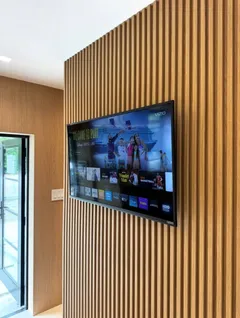
Where the wall can't be opened — concrete in high-rise condos, brick, stone fireplace surrounds, or a rental where you can't cut drywall — we use a raceway. It's a slim, low-profile channel fixed to the wall in straight lines from the TV down to the outlet or console, with a snap-on cover that hides the cables.

Done well, a raceway is surprisingly discreet, especially once it's painted the wall color. We cut the lengths precisely, use corner pieces rather than bending the channel, and keep it plumb and parallel to the TV so it reads as part of the wall. See the raceway guide for examples.

Free tools Wire Hiding Kit Builder A complete parts list for both routes — inside the wall or a paintable raceway — with the right cable length for your run. Open the tool →

Which one is right for your wall

WallUsual choice
Drywall over wood studsIn-wall concealment
Drywall over metal studsIn-wall concealment
Plaster and lathIn-wall, when the route is clear
Poured concrete, block, brickRaceway
Stone or tiled fireplaceRaceway, or in-wall through a framed chase
Rental apartmentRaceway (no cutting)

The wire concealment planner asks a few questions about your wall and suggests an option. If you're not sure, just say so in your request — the technician will confirm on site, and the price is adjusted if the other option makes more sense.

Rather have a pro do it?

Send a request — we'll confirm the exact price and a time that suits you by text or call. 3-year warranty on every install.

Call (877) 676-8880

Hiding wires for the whole setup

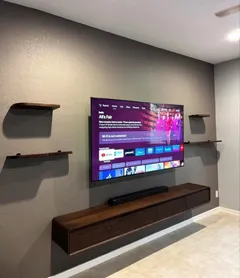
Most setups have more than a TV: a soundbar, a game console, a cable box or a streaming device. We plan the route for everything at once. Often the devices move into a console or onto a shelf below the TV, and all their cables come through the same lower opening or raceway.

If you're adding a soundbar, its cable runs with the TV's. A floating shelf or media stand can hide the lower plate completely, and a multi-screen media wall — several TVs joined into one picture — gets every screen's power and HDMI planned the same way. On a Samsung Frame, the One Connect cable or the power at the TV is planned the same way, and the One Connect box can go inside the wall in a media enclosure — see Frame TV installation. For the full picture of what each cable needs, read hiding HDMI and power cables.

Renters and HOA rules

If you rent, raceway is the way to go: it goes up with a few small screws or adhesive, and comes off at move-out with little to patch. Some condo associations have rules about opening walls shared with neighbors or containing fire barriers — we know how those rules usually work in our regions and will tell you what's allowed. The renters' guide to wire concealment has more detail.

Cable concealment in our regions

We hide TV wires every day in Miami and South Florida — where concrete condo walls mean raceway is common — and in Los Angeles, Dallas–Fort Worth, Las Vegas, Houston, Atlanta, Chicago, San Diego, Charlotte, Salt Lake City, Seattle and Raleigh–Durham, where framed walls make in-wall concealment the usual choice. Same prices, same-day slots, and a 3-year warranty everywhere.
How it works

How we hide TV wires, step by step

  1. Step 1

    Choose in-wall or raceway

    Note your choice in the request; if you're unsure, the technician will confirm what your wall allows on site.

  2. Step 2

    Scan and plan the route

    We scan the wall for studs, fire blocks, plumbing and electrical, and mark where the plates or raceway will go.

  3. Step 3

    Open the wall or fit the raceway

    For in-wall, two neat openings are cut for recessed plates; for raceway, the channel is cut to length and fixed in straight lines.

  4. Step 4

    Run cables and power

    In-wall rated HDMI and the power kit are pulled through, or the cables are laid in the raceway and the cover snapped on.

  5. Step 5

    Connect, test and clean up

    Devices are connected and tested, the plates are fitted, dust is vacuumed and the raceway is ready to paint.

Pricing

TV Cable Concealment pricing

ServicePrice
External (cable raceway)$39
Internal (inside the wall)$69
Up to 60"$119
61–85"$129
Soundbar installation$69

Concealment is priced per TV and added to the installation. If your TV is already on the wall, we can hide the wires as a stand-alone visit — we'll confirm the price either way when you send a request.

Full price list →
Where we work

TV Cable Concealment in every region we serve

The same crews, the same flat price list and the same 3-year warranty in every region — and no travel fee anywhere inside the service area.

Related guides from our blog

Installation Tips

How to Hide TV Wires In the Wall (In-Wall Cable Concealment Guide)

The code-compliant way to run TV cables inside a wall: in-wall power relocation kits, why extension cords are not allowed, fire blocks, and what to do on concrete and block walls.

3 min read
Wire Management

How to Hide HDMI and Power Cables Behind a Mounted TV

Three methods that actually work — in-wall kit, paintable raceway, furniture routing — plus the HDMI details people miss: in-wall ratings, length, eARC for soundbars and 2.1 for consoles.

2 min read
Wire Management

How to Hide TV Wires Without Cutting Drywall: Complete Raceway Guide

Don't want to cut into your walls — or can't, because they are concrete? How to choose, cut, mount and paint a cable raceway so it disappears, with sizes and routing tips.

2 min read
Wire Management

Apartment-Friendly TV Wire Concealment: No-Drill Solutions for Renters & Condos

Renting an apartment or condo? Hide TV cables without damaging walls: paintable raceways, cord covers, cable spines and furniture tricks that come off clean at move-out.

2 min read
Installation Tips

Condo & High-Rise TV Mounting in Miami: HOA Rules, Metal Studs and Concrete

How TV mounting works in Miami condos and high-rises: certificates of insurance, service elevators and drill hours, 25-gauge steel studs, post-tensioned concrete and what associations allow for cables.

3 min read
DIY Guides

How to Mount a TV on Concrete or Brick: Tapcon Sizes and Steps

Under 75 inches: 3/16-inch Tapcons or 3/8-inch sleeve anchors into solid concrete, block or brick. Bigger screens and full-motion arms need more anchors. Hollow block, furring strips and the steps, from an installer who drills block every week.

4 min read

Free planning tools

TV Cable Concealment: frequently asked questions

How much does it cost to hide TV wires?
A paintable raceway on the wall surface is $39 per TV, and in-wall concealment with a recessed power kit is $69 per TV. Both are added to the TV installation price, or booked on their own if your TV is already mounted.
Is it safe to run a TV power cord inside the wall?
An ordinary power cord is not rated for in-wall use and shouldn't be run inside a wall. We use an in-wall power kit: an in-wall rated cable between a recessed inlet near the floor and an outlet behind the TV. That's the safe, code-compliant way to do it.
Can you hide wires in a concrete or brick wall?
Solid concrete and brick can't be opened like drywall, so we use a slim raceway that can be painted to match. In high-rise condos with concrete walls, that's the standard. See TV mounting in high-rise condos.
I'm renting — what can I do?
The raceway option doesn't cut into the wall and comes off at move-out, leaving only small screw holes. Our guide for renters covers the details.
Can you hide wires for a soundbar and a console too?
Yes. We route all the cables together — soundbar, console, streaming box — through the same openings or raceway. Mention the extra devices when you book.

What customers say

★★★★★

"Mounted a 75" above the fireplace and hid every cable. Showed up on time, done in about an hour, left the room cleaner than they found it."

— Daniel R.
★★★★★

"Got the price online in a minute, booked for the same afternoon. Exactly the number I was quoted, no surprises."

— Maria G.
★★★★★

"Three TVs, two wall types, one visit. The full-motion mount in the kitchen corner was a great call."

— Kevin P.