In this article
When a pull-down beats a tilting mount
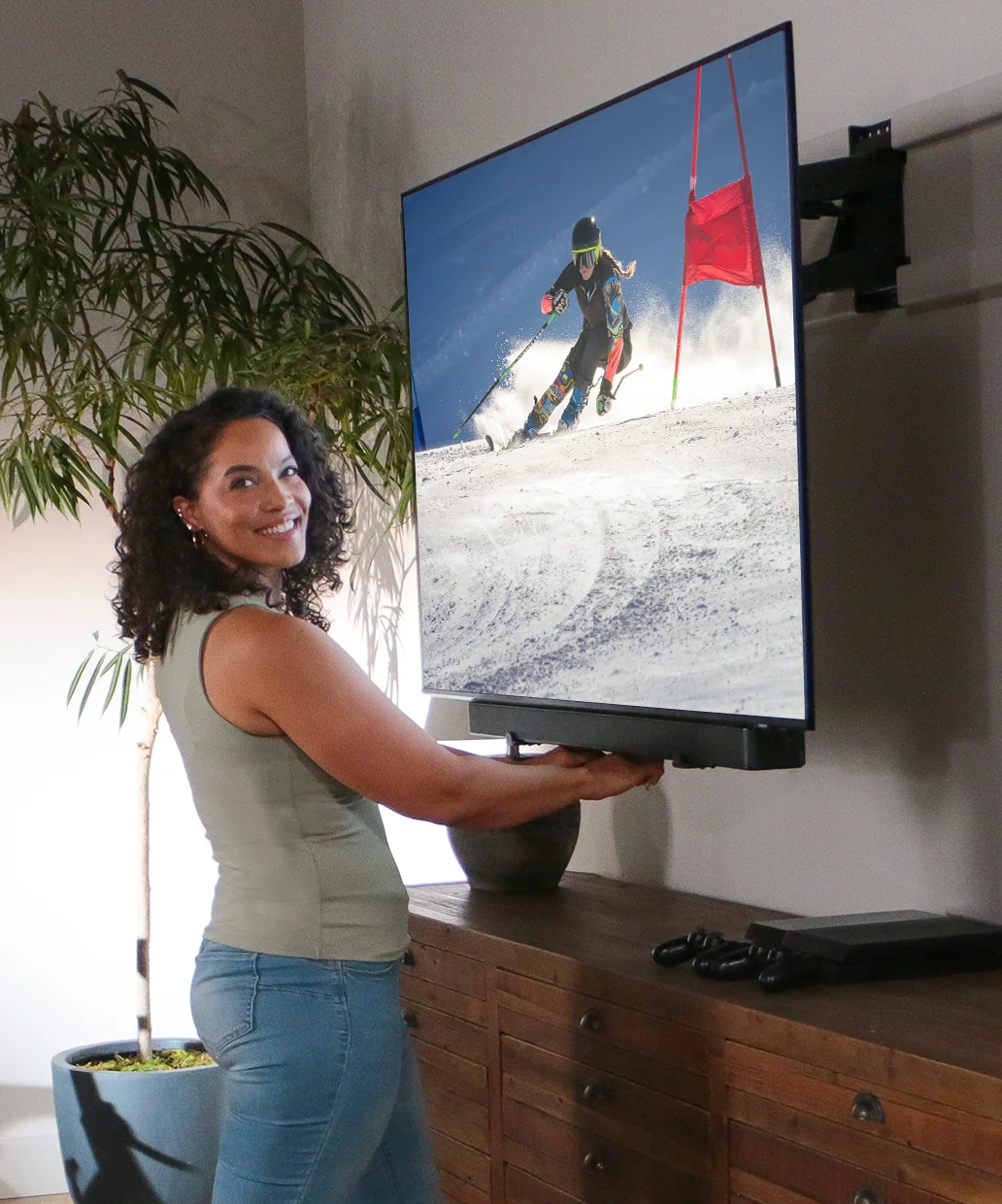
The mantels we measure around Los Angeles usually stand 50 to 60 inches high, so a TV hung flat above one ends up with its center near 75 inches. Tilt fixes the angle and leaves the height; a pull-down brings the whole screen down to sofa level for the evening and returns it to the wall afterward. About 3 in 4 of the TVs on our pull-down mounts are 65 to 85 inches — the big sets, where a picture up near the ceiling is hardest to live with.
It is not always the right call. About 1 in 6 people who ask us for a pull-down end up with a tilting mount instead, either because the shelf sticks out farther than the arm can clear or because the brick above it is sound enough for a fixed load but not for the leverage of an arm that moves every evening. For how the mechanism works in general, see mantel mount installation.
Shelf depth, drop and the recess question
Depth eliminates models fastest. MantelMount's MM540 gives 27 inches of drop over a mantel up to 18 inches deep; the motorized MM815 travels 26 inches and clears no more than 16. Post-war ranch houses — the 1950s and 1960s ones we meet in Torrance, for instance — tend to have used-brick fireplaces, and a deep used-brick shelf can rule out one arm or both, so shelf depth is the first number we ask for.
Recessing the housing is a framing question. The MM750 Pro can sink in for 1.8 inch flush-to-wall storage, but only into a hollow bay clear of the flue and its required clearances; a solid chimney breast has none, so on brick our pull-downs mount on the surface. Before you buy, read our pull-down mount guide and try stored and lowered heights in the fireplace calculator.
Bungalow river rock, ranch-house brick and framed chases
The other third of our mantel mounts went into a framed chase. FEMA's guidance is to fasten into studs, concrete or masonry and never into plaster or gypsum board alone. Because plaster was the wall surface of nearly all buildings until the 1930s or 40s, in older houses we find the brick or stud behind it before the plate is marked.
A framed chase is the easier wall. Wood-framed houses have traditionally been built with studs 16 inches on center, and the MM540 and MM750 Pro reach studs up to 24 inches apart. The hard faces are in neighborhoods like Bungalow Heaven in Pasadena, where most bungalows went up between 1905 and 1920 with brick and stone, river-rock boulders included, on their chimneys and fireplaces. There we set a rigid backer across the high points and shim it until it bears evenly: with an arm that moves every evening, any play works the plate loose over time.
A moving TV in earthquake country: stops and tethers
FEMA's advice for any bracket that can be adjusted into different positions is to make sure it cannot swing into a window or a light, and to consider a safety cable or tether that limits its range of motion. That counts double for an arm that travels down and out, and in the living rooms we work in, the fireplace often has a window beside it.
Steve and Carla N. in Woodland Hills have a 1970s used-brick fireplace with a deep mantel and a window right next to it. Kostiantyn set the arm's side stops so their 75-inch cannot swing into the glass. Like every mount we hang, it was pull-tested at twice the screen's weight before we left.
Rather have a pro do it?
Send a request — we'll confirm the exact price and a time that suits you by text or call. 3-year warranty on every install.
Gas logs on No-Burn nights
The MM815 carries a heat sensor that turns red above 110° F to warn that the fireplace is too hot for electronics. Treat it as a backstop rather than a plan. In the South Coast basin, No-Burn alerts exempt gas fireplaces, so gas logs keep running on cold winter evenings — exactly when a lowered TV sits closest to the firebox. On a pull-down job we take readings with the fire on at both spots: where the TV is stored and where it stops when lowered in front of the mantel. While the fire is burning, the screen stays up.
How a pull-down visit goes
Plan on about 3 hours on site, including weighing the TV, setting the spring tension and fitting the stops. The weighing matters more than it sounds: in Mission Viejo, Owen P.'s 85-inch kept creeping back up after the first tension setting, which had been made with the stand still on the scale, so Oleh reweighed it with the stand removed and reset the spring. Our bill has two lines — installation by screen size, $129 for a 61- to 85-inch set, and $99 to assemble and tune the pull-down arm. The arm itself you buy, and we tell you which one fits.